Choosing an alignment mode
The Rust bismark aligner can run several ways. The faithful default reproduces Perl v0.25.1
byte-for-byte; the opt-in combined index is usually faster and can be lighter, at the cost of being
concordance-gated rather than byte-identical. This page is a short decision guide — the numbers behind
it are on the Benchmarks page, and each flag is described under
Alignment.
All combined modes need a one-time combined index:
bismark prepare --combined_genome /path/to/genome/and they scale with Bowtie 2 threads (-p), not --multicore (which is rejected in combined mode).
Quick guide
Section titled “Quick guide”Pick your library row, then your priority:
| Library | ⚡ Fastest / least CPU | 🔒 Byte-identical to Perl | 💽 Memory- or disk-constrained |
|---|---|---|---|
| Directional | --combined_index (one pass, tune -p) |
standard, 2 instances | combined is already light (+~1.3 GB, no spill) |
| Non-directional | --combined_index_sequential — fastest and leanest RAM |
standard, 4 instances | low RAM + have disk → sequential · low disk → --combined_index_single_pass† or --combined_index (parallel) |
| PBAT | --combined_index (one pass, tune -p) |
standard, 2 instances | combined is already light |
† --combined_index_single_pass is not decision-equivalent — see Correctness.
Directional and PBAT
Section titled “Directional and PBAT”For directional and PBAT libraries the combined index is a clean win: one both-strands pass replaces the two per-strand instances, so it is faster at every core budget and uses about 22–28 % less CPU, for a fixed ~1.3 GB memory premium that does not grow with read count.
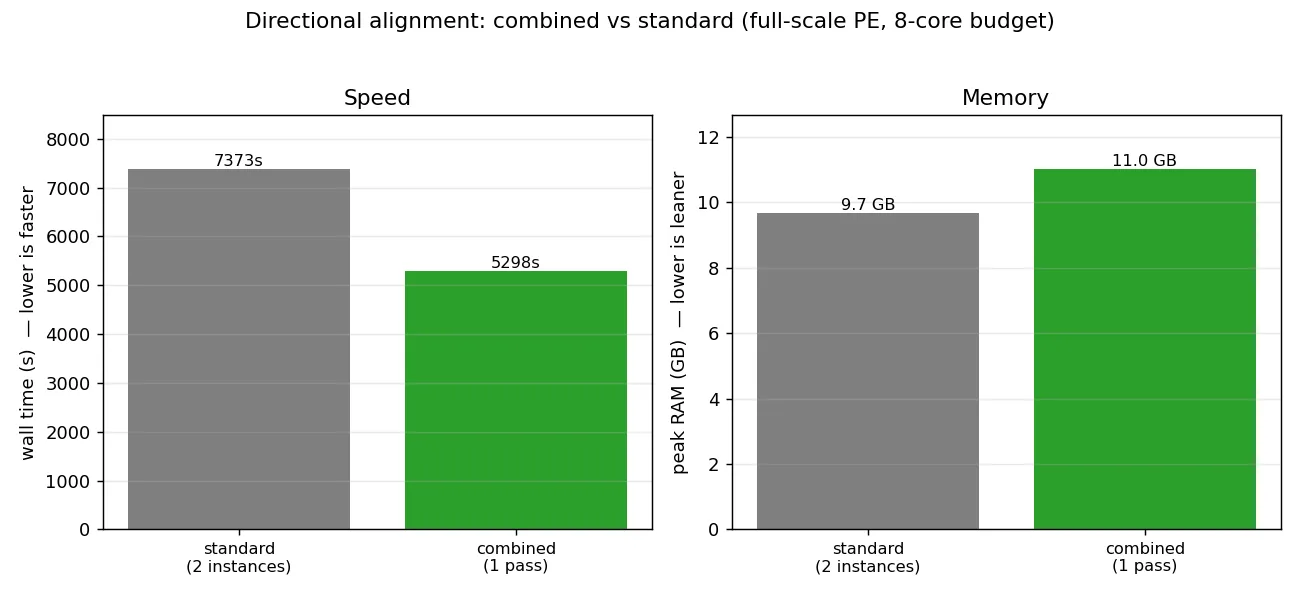
If you need output byte-identical to Perl v0.25.1, use the standard per-strand index (omit
--combined_index).
Non-directional
Section titled “Non-directional”Non-directional has the most choices, because the combined index can run its two both-strands passes three ways. They differ sharply on memory and disk:
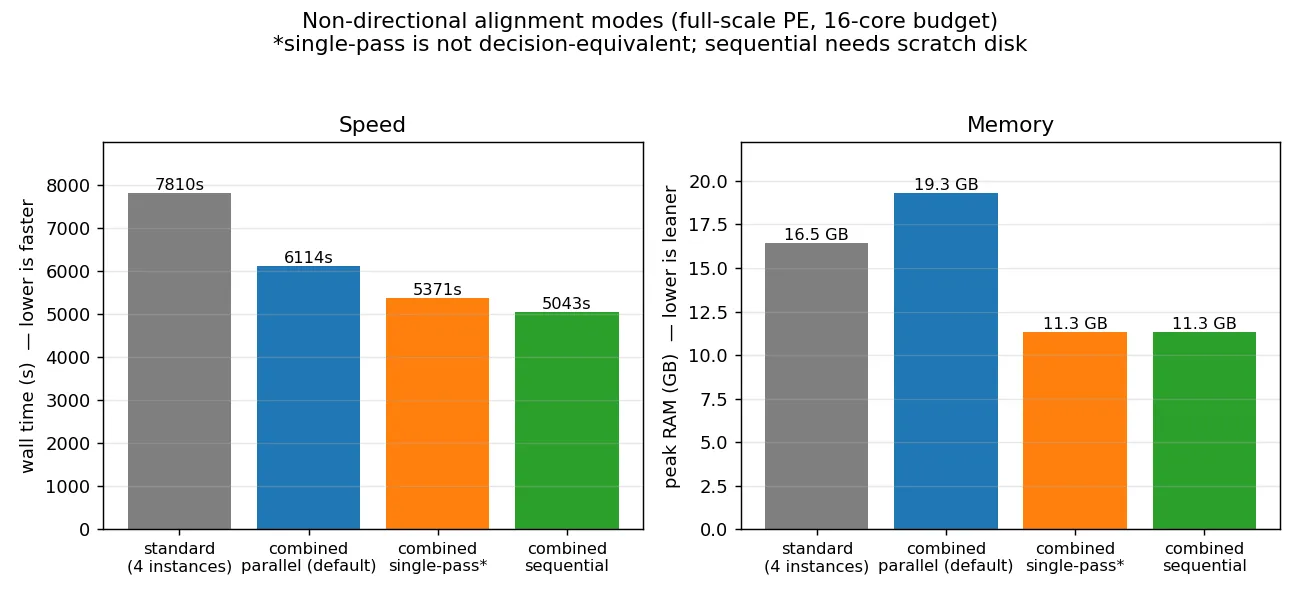
--combined_index_sequential— recommended. Runs the two passes one at a time, so it is the fastest and uses the least RAM (~11 GB), and it is byte-identical to the parallel combined run. Its one cost is a small BGZF-compressed scratch spill (see the note below).--combined_index_single_pass— just as fast and light, with no disk spill, but not decision-equivalent (a read-name tag perturbs Bowtie 2’s RNG, so ~1 read in 10,000 is placed differently but equally validly). Use it when disk is tight and that tiny non-equivalence is acceptable.--combined_index(parallel — the current default) — no disk spill, but keeps two combined indexes resident (~19 GB) and is the slowest combined mode. Use it when you have neither spare disk nor a reason to prefer the others.- standard (4 instances) — the only byte-identical-to-Perl non-directional option.
Correctness / concordance
Section titled “Correctness / concordance”The combined index is opt-in and never silent; it trades exact reproduction for speed:
- Byte-identical to Perl
v0.25.1→ only the standard per-strand modes. - Concordance-gated (benign ~0.01–0.04 % churn versus the faithful result, almost all
unique↔ambiguous flips at cross-sub-genome ties) →
--combined_index(parallel) and--combined_index_sequential, which are byte-identical to each other. - Not decision-equivalent (the above, plus a tiny RNG-perturbed reassignment) →
--combined_index_single_pass.
If your pipeline requires bit-for-bit reproduction of Perl Bismark output, stay on the standard index. For everything else, the combined index is the faster choice.